Don’t invest unless you’re prepared to lose all the money you invest.
Cryptoassets are high risk, highly volatile and can fall in value quickly, including to zero.
Griff Coin is an experimental crypto project. There is no guarantee of profit, value, liquidity or continued trading availability.
Always verify the official mint address before trading. Fake tokens can use the same name and branding.
Nothing on this website is financial, investment, legal or tax advice.
Only use money you can afford to lose.
Important: This is a personal account of my learning experience, not financial advice. Cryptoassets are high risk and can lose all of their value.
Griff Coin
One man. One little coin. Let’s see where it goes.
How I Created Griff Coin
A hungover Saturday, a rabbit hole, a few failures, some risky decisions, and one very real Solana token
I didn't wake up planning to create a cryptocurrency. To be fair, I was barely planning to do much of anything that day.
The whole thing started because I was hung over on a Saturday morning.
The night before, while having a drink, the conversation had somehow drifted onto cryptocurrency. We were talking about how coins and tokens actually work, where their value comes from, who creates them, and how they end up on an market. The funny part was that we all knew what crypto was, but none of us could properly explain what was happening underneath it. The more we talked, the more obvious it became that we were all confidently discussing something none of us really understood.Saturday morning came around and I skipped my usual Kung Fu class. I was sitting at my computer with a coffee, two paracetamol and the dog at my feet, feeling slightly sorry for myself. The conversation from the night before was still rattling around in my head, so I started reading. This was supposed to be a quiet morning. It did not stay that way for long.
That was the beginning of the rabbit hole.At first I only wanted answers to a few questions. By that evening I had downloaded software, opened command prompts, installed tools I had never heard of the day before and started trying to build a cryptocurrency token on Solana. Somewhere between the coffee and the command line, 'I'll just have a quick look' had turned into a full weekend project. I went to bed still thinking about it. On Sunday morning I got straight back on the computer, and by Sunday night Griff Coin existed for real.
That makes it sound far smoother than it actually was. The weekend included failed faucets, software problems, a hard drive that picked the worst possible time to run out of space, a testing environment that refused to cooperate, irreversible decisions, a liquidity transaction that appeared to time out, and the slightly surreal experience of watching strangers trade something I had created less than two days earlier. In other words, a perfectly normal relaxing weekend.This is the full story of how I got from 'how does a meme coin actually work?' to launching GRIFF on the market.
The question that started it
I had bought and traded crypto before, but there is a huge difference between using a cryptocurrency and understanding how one is actually created. I knew people could launch tokens. I knew meme coins appeared constantly. What I did not understand was what technically turned an idea into a real asset on a blockchain.I wanted to know what the mint was, where the supply lived, what made one token 'official', what a wallet really controlled, how a decentralised exchange knew a token existed, how a price was created when there had never been a price before, and what liquidity actually meant in practice.The easiest way to understand it seemed obvious: build one. In hindsight, there were probably easier ways to spend a Saturday.The project was never supposed to begin with a sales pitch. I was not setting out to claim I had found the future of finance. I wanted to learn by doing, and Griff Coin became the experiment.
Giving the experiment some rules
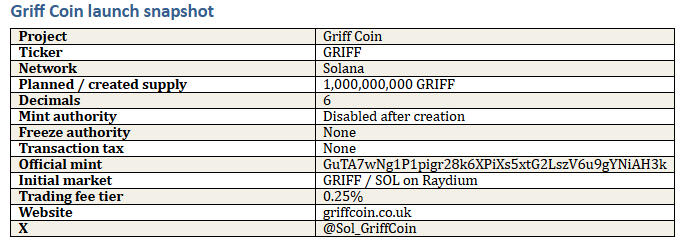
Once I decided I was actually going to create a token, I needed to stop treating it like a vague idea and give it some rules.I settled on the name Griff Coin, with the ticker GRIFF, running on Solana. The planned supply was one billion GRIFF with six decimal places. I didn't want transaction taxes, and I didn't want a hidden ability to freeze people's tokens later.Most importantly, I wanted the supply to be fixed. I found out that a token creator can retain a mint authority that allows more tokens to be created later. For my experiment, I wanted to understand the consequences of giving that ability up, so the plan was to create the full supply and then permanently disable the mint authority. I also wanted no freeze authority.Those choices mattered because blockchain settings are not like ordinary website settings. Some of them are irreversible. Once an authority is removed, there is no customer-service department, no password-reset email and no friendly 'Are you sure?' button appearing at the last second.
Testing first - at least that was the plan
One thing became obvious very quickly: launching straight onto Solana Mainnet without testing would be reckless. On a blockchain, mistakes can cost real money and some mistakes are permanent.So I started with Solana Devnet, the test network. The idea was to create a disposable version of the process using test SOL, prove that I understood the commands and sequence, and only then use real funds.That is the sensible version of the story. The reality was messier, which turned out to be a recurring theme.The Devnet faucets were either failing, rate-limited or simply not giving me what I needed. I ended up trying a proof-of-work route just to obtain test SOL. That meant installing more tooling and building software locally before I had even managed to complete the first proper test. My simple experiment was already starting to look suspiciously like work.Then that failed too. Part of the problem was not Solana at all - it was my own computer. The main system drive was almost full, and the build process needed more working space than I had available. I cleared space, moved the build work away from the cramped system drive and tried again. It was a useful reminder that even cutting-edge blockchain technology can still be defeated by the timeless problem of 'your disk is full'.Eventually the extra tooling installed, but the wider Devnet setup still refused to give me the clean end-to-end test I wanted. I ran into configuration issues and missing pieces, and I still did not have the smooth rehearsal I had imagined when I started. By this point, Devnet felt less like a test network and more like a test of my patience.
The dangerous temptation: just launch it
This was the point where the project could easily have gone wrong.When testing becomes frustrating, there is a powerful temptation to tell yourself that you understand enough and just move onto the real network. I could feel that temptation creeping in. That was exactly the dangerous approach I had been trying to avoid.A blockchain is very good at exposing confidence that has not been backed up by verification. A typo in an address can send assets somewhere I can never recover them from. Disabling the wrong authority can be permanent. Losing control of a wallet can be permanent. Sending the wrong amount of liquidity can be expensive. There is no big red Undo button quietly waiting in the corner.I never got the perfect Devnet rehearsal I wanted. In the end I decided to proceed to Mainnet anyway, fully aware that I was increasing the risk. I slowed everything down, checked addresses repeatedly, kept the initial amount of real SOL small, and treated every irreversible step as something that deserved one more check than I thought it needed.It worked, but I would never use that as evidence that skipping a complete test is good practice. Getting away with something is not the same as doing it properly. If anything, it became one of the clearest lessons from the whole project: when money and irreversible transactions are involved, testing is not boring admin. It is protection.
Creating the real wallet
For Mainnet I created a dedicated Solana wallet. The public wallet address was separate from the private credentials that actually controlled it.That distinction was one of the first concepts that really clicked for me. A public wallet address can be shared. The private credentials absolutely cannot. Whoever controls them controls the assets. There is no bank manager to ring on Monday morning if I get that wrong.I initially funded the wallet with a small amount of SOL - around 0.076 SOL at one stage - so I could begin making real transactions without putting a large amount at risk while I was still learning.The wallet credentials were stored locally and suddenly felt far more important than an ordinary computer file. They were effectively the keys to the wallet. That changed how I thought about backups, security and the phrase 'do not lose this' very quickly.
Griff Coin becomes real
Then came the step that turned Griff Coin from an idea into an actual token on Solana.I created the mint, created the token account, and produced the planned one billion GRIFF supply with six decimals. After verifying the supply and ownership, I disabled the mint authority permanently. The freeze authority was also absent, as planned.Griff Coin existed. I had actually done it.What had started as an idea now had a fixed supply and its own permanent address on Solana. It was a moment worth stopping for: I had created my own cryptocurrency.The official Griff Coin mint address became:
GuTA7wNg1P1pigr28k6XPiXs5xtG2LszV6u9gYNiAH3kThat long string is more important than the name or logo. Anyone can create another token and call it Griff Coin. The mint address is what uniquely identifies the real token on Solana.Once the excitement settled, though, I realised there was another step. I had created a cryptocurrency, but I had not created a market. Owning a billion tokens in my own wallet did not mean they had a meaningful price. For that, the next subject I had to understand was liquidity.
Learning what liquidity actually means
Before this project, 'liquidity' was one of those crypto words I understood well enough to nod along when somebody said it. Building Griff Coin forced me to understand what it actually meant.A decentralised exchange does not need a traditional buyer and seller to be manually matched for every trade. Instead, a liquidity pool can hold both assets in a pair - in my case GRIFF and SOL - and the pool enables swaps between them.That also means the starting liquidity matters enormously. If a pool contains very little real value, even a modest trade can move the price violently. Later, when I tested what a 1 SOL trade would look like, Raydium showed roughly a 369% price-impact warning. That was a very effective demonstration of just how thin the early liquidity was.This was another useful lesson: a token can have a market price on a screen while still being extremely illiquid. Market cap, price and actual cash available to absorb trades are not the same thing.
The liquidity transaction that looked like it had failed
The next major step was creating the GRIFF/SOL liquidity position on Raydium.The launch plan left roughly 100 million GRIFF outside the initial pool and used about 900 million GRIFF for liquidity alongside SOL. The pool used Raydium's 0.25% trading-fee tier.This was probably the most stressful technical moment of the launch. The liquidity transaction appeared to time out. Naturally, this happened at exactly the point where real assets were involved.For a few minutes I was in the worst possible position for a beginner: real assets had been involved, the interface had not given me the clean success message I expected, and I did not immediately know whether the transaction had failed, partially succeeded or completed on-chain while the front end had simply stopped waiting. My confidence level dropped considerably faster than the loading spinner.The important thing was not to panic and repeat the transaction blindly. Doing that could have created a much bigger problem. I checked the wallet and the blockchain state instead.The pool had in fact succeeded. I was relieved enough to forgive the interface eventually.That was a huge moment. Griff Coin was no longer just sitting in my wallet. It had a live GRIFF/SOL market on Raydium.
The first trades - including my own
Once the pool existed, I tested it myself. I bought another chunk of GRIFF through the market using a small amount of SOL. I wanted to prove that the pool actually swapped in both directions and that this was not just an entry on a blockchain explorer.Then something more interesting happened: other trades began to appear. That was the point where it stopped feeling like something that only existed on my own screen.At one point I could see around seven holders and more than twenty trades. The pool was still tiny - roughly 0.26 SOL paired with hundreds of millions of GRIFF, representing only tens of pounds of practical liquidity at the time - but people other than me were interacting with it.That was strange to watch. I had spent the weekend thinking of GRIFF as a learning exercise on my own computer. Suddenly somebody somewhere was choosing to swap SOL for it. I had no idea who they were, which somehow made it feel even more real.It did not magically make the project valuable, and it certainly did not make it safe. But it did prove something important: the full chain worked. The token existed, the pool existed, wallets could hold it, and independent users could trade it.
Discoverability was another problem entirely
Getting a token onto a market does not mean every crypto service immediately knows what it is. I discovered that 'it's live' and 'everyone can find it' are two very different things.Raydium could trade GRIFF because the pool existed. Solana explorers could see the mint because it was on-chain. But other services did not automatically recognise the name, logo and metadata.I checked places such as Phantom, Solscan, Jupiter, DexScreener, GeckoTerminal and Birdeye. Recognition was inconsistent. Some services could see the underlying token or transactions but did not yet show Griff Coin as a polished, indexed project. Others had no confirmed listing at all.That was another misconception removed. 'Launching a coin' is not one single event. There is creating the token, creating liquidity, making it tradeable, publishing metadata, getting explorers to display it properly, getting indexers to discover the market and then giving people a trustworthy place to verify what they are looking at.
Building the public side
Once Griff Coin was live, I realised the technical token was only half the project. If somebody found it, they needed to know whether they had found the real one.I created the Griff Coin X account and started sharing the project publicly. The tone mattered to me. I did not want to pretend I had a team of developers or that I was launching the next world-changing financial system. I wanted it to be clear that I was learning as I went and building in public.I also bought griffcoin.co.uk and built a simple website. The site includes the story, roadmap, official mint address, links to Solana explorers, the Raydium trading route, risk warnings and contact information.The public-facing message became simple: no fake hype, no unrealistic promises, just an experiment to see what I could build and what I could learn.
What went right
A surprising amount went right over one weekend, especially considering how the weekend had started.I went from knowing only the consumer side of cryptocurrency to creating a live Solana token, producing a fixed supply, removing the mint authority, creating a liquidity market, completing live swaps and watching other wallets interact with the token.I also learned enough to recognise things I would previously have ignored: price impact, pool depth, token authorities, mint verification, blockchain explorers, metadata, wallet security and the difference between a token existing and a token being discoverable.The biggest success was not that Griff Coin suddenly became worth a fortune. It did not. The success was that the experiment actually answered the question that started the whole thing. I now understood far more about how a token moves from an idea to something that can genuinely be traded on-chain.
What failed - and why the failures were useful
The failed parts probably taught me more than the successful commands. Annoying at the time, useful afterwards - which is unfortunately how a lot of learning seems to work.The Devnet faucets failed. The proof-of-work workaround created more software problems. The build ran into disk-space limits. The Solana test environment did not give me the smooth rehearsal I wanted. The liquidity transaction appeared to time out even though it had succeeded. Token metadata and external indexing did not magically happen when the market opened. Every time I thought I had reached the end of the process, another layer appeared.Every one of those problems exposed another layer of the system I would not have learned by simply paying someone else to launch a token for me.It also showed me why copying a tutorial without understanding it can be dangerous. A tutorial can tell me what command to type. It cannot guarantee that my environment, wallet, network, balances or transaction state match the person who wrote it.
The lesson I would emphasise most: test properly
If I repeated the project from scratch, I would put even more effort into getting a complete Devnet rehearsal working before touching Mainnet.I was cautious with the amount of SOL I used, and I checked critical steps repeatedly, but I still moved forward without the full test I originally wanted. That increased the risk unnecessarily.The dangerous thought is: 'It is only a small amount, so I will just try it.' I had that thought more than once. The problem is that habits scale. If I am careless with a small transaction while learning, I can be careless with a large transaction later when the consequences are much worse.I came out of the weekend with a functioning token. I could just as easily have come out of it with lost SOL, an incorrectly configured mint or assets sent somewhere unrecoverable. That possibility is worth saying plainly because launch stories often leave out the parts where things could have gone very wrong.
Sunday night: the moment it felt real
By Sunday night, less than two days after sitting at my computer with a coffee, two paracetamol, a hangover and the dog at my feet, Griff Coin was real.It had an official Solana mint. The supply existed. The authorities were set the way I wanted. Liquidity had been added. The token could be swapped on Raydium. The first trades had happened.I had gone from a conversation over drinks about nobody really understanding cryptocurrency to having built one myself. That sentence still feels slightly ridiculous when I read it back.That did not suddenly make me a crypto expert. If anything, the experience showed me how much more there is to learn. But the subject was no longer abstract. I had watched each layer connect to the next: wallet, mint, supply, authority, liquidity pool, price, trade, explorer, metadata, website and community.Griff Coin started as a question. By Sunday night, it had become an answer I could actually inspect on the blockchain.
Where Griff Coin goes from here
I am still treating Griff Coin as an experiment rather than pretending I know where it will end up.The next goals are to keep the project transparent, improve visibility and verification, grow a genuine community, gradually improve liquidity, make the website easier to understand and continue learning in public.I am also much more conscious now of the responsibilities that come with putting something tradeable into the world. Crypto is high risk. Thin liquidity can move violently. People can lose money. A fun technical experiment for me can become a financial decision for somebody else, and that deserves clear warnings rather than hype.I cannot promise that Griff Coin will become valuable. I cannot promise that it will become a big project. What I can say is that it exists, I built it myself, I understand far more than I did on Friday night, and I am going to keep documenting what happens next.
A final note
I am publishing this because I think the messy version is more useful than pretending the whole thing was effortless. It definitely was not effortless, and any version of the story that says otherwise would be fiction.I made decisions I would handle differently next time. I hit errors I did not expect. I moved onto Mainnet without completing the perfect Devnet test I wanted. I had moments where the interface told me less than I needed to know and I had to verify what had actually happened on-chain. There were also several moments where staring at the screen harder did absolutely nothing, although I gave it a fair try.But I also proved something to myself: complicated systems become much less mysterious when I stop treating them as magic and start taking them apart one piece at a time.On Saturday morning I was hung over, I had missed Kung Fu, and I was trying to understand a conversation from the night before. On Sunday night I had a live cryptocurrency on Solana. Not quite the weekend I had planned, but definitely one I will remember.That is Griff Coin.Important: This is a personal account of my learning experience, not financial advice. Cryptoassets are high risk and can lose all of their value.
STAY CONNECTED
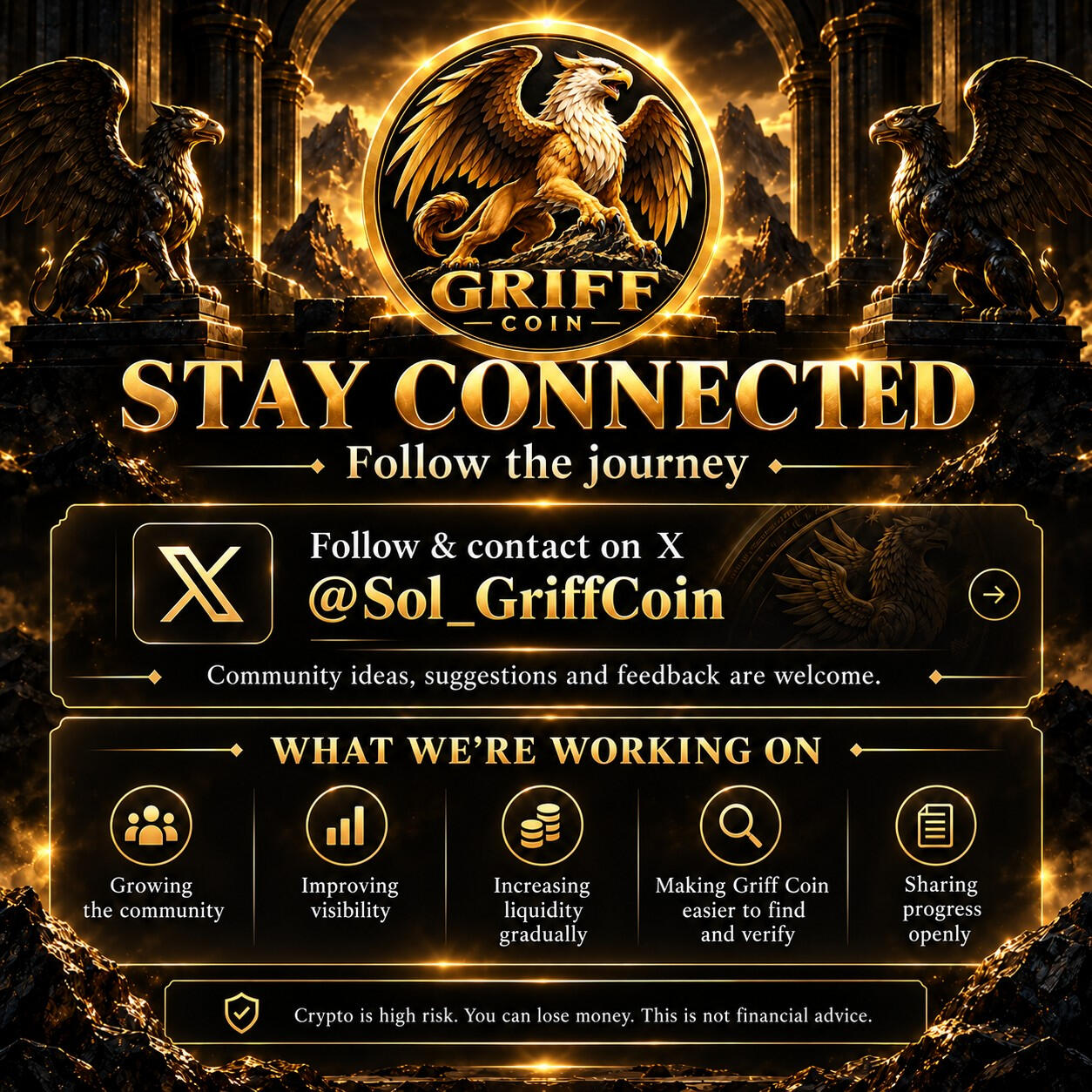
Griff Coin is still growing. The aim is to build a genuine community around the project, improve visibility, grow liquidity gradually, and keep developing the project step by step.If you have ideas, suggestions, feedback or simply want to follow the journey, come and find Griff Coin on X.What we’re working on -
- Growing the community
- Improving visibility
- Increasing liquidity gradually
- Making Griff Coin easier to find and verify
- Sharing progress openly
- Exploring future ideas as the project grows
RISK & LEGAL INFORMATION
High-risk cryptoasset -
Don’t invest unless you’re prepared to lose all the money you invest. Cryptoassets are highly volatile and their value can fall rapidly, including to zero.No financial advice -
Nothing on griffcoin.co.uk, the Griff Coin X account, or any associated social-media account is financial, investment, legal or tax advice.
Information is provided only to describe the Griff Coin project and its development.No guarantee of value or returns -
There is no promise or guarantee that Griff Coin will increase in value, maintain any particular value, remain liquid or continue to be tradeable. Past or current market activity is not an indication of future performance.Liquidity and trading risk -
Griff Coin may have limited liquidity. It may be difficult or impossible to sell tokens at the price you expect, and buying or selling can materially affect the market price.Technology and third-party risk -
Griff Coin operates using blockchain technology and relies on third-party wallets, exchanges, decentralised exchanges and other services. These may experience technical failures, hacks, outages, errors or changes outside the control of the Griff Coin project.Do your own research -
Anyone considering acquiring Griff Coin should independently research the token, verify the official mint address and understand the risks before making any decision. Never spend money you cannot afford to lose.No consumer protection guarantee -
Cryptoasset purchasers may not have access to protections such as the Financial Services Compensation Scheme or Financial Ombudsman Service if something goes wrong.Project status -
Griff Coin is an experimental community crypto project.
Features, plans, liquidity, availability and the roadmap may change or be discontinued.Official information -
The official website is griffcoin.co.uk and the official X account is @Sol_GriffCoin. Always verify the mint address using the information published on this website.Legal and tax responsibility -
Users are responsible for determining and complying with any legal, regulatory or tax obligations that apply to them in their own jurisdiction.Last updated: October 2026